|
 |
|
|
|
|
|
|
| county:- |
Cumbria |
|
|
|
There was a flourishing iron industry in south west Cumbria in the 18th and 19th centuries,
which grew out of medieval ironworkings. The sandstone and limestone formations in
the area hold deposits of high grade haematite iron ore; there is broad leaved woodland
for charcoal fuel; and water power from streams.
|
|
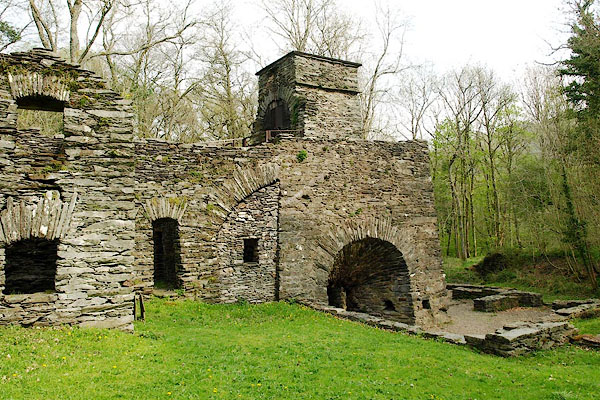
BQK38.jpg Duddon Iron Furnace
|
|
Iron ores are oxides of iron: FeO, Fe2O3, and Fe3O4 which is compound of the two other oxides. Iron can have a valency of 2 or 3. Ores are found mixed with earthy materials which are removed by dressing processes, and might contain other elements, such as sulphur. The oxygen in the ore can be removed by heating with carbon which has a greater affinity for oxygen; iron oxide plus carbon becomes iron plus carbon monoxide, the latter burns to form carbon dioxide.
|
|
|
|
The extraction of iron by direct reduction, the process of heating ore with charcoal,
carbon, was discovered in the Middle East 4000 years ago. A bloomery is a small furnace
built out of clay in which iron ore is placed on a charcoal fire which was blown by
bellows. The product was fist sized pieces of wrought iron from which tools and weapons
could be made. Direct reduction reached Britain about 450BC. The Romans improved and
expanded ironworking from south east England into the Forest of Dean and south Wales.
From the 13th century bigger furnaces were possible, the bellows powered by a water
wheel.
|
|
|
|
In the 15th century the blast furnace was invented near Liege, Belgium. The first
blast furnace in Britain was at Newbridge, Sussex, 1496. The chemistry is the same;
iron ore, charcoal fuel, and a strong air blast, but working in a continuous process.
The furnace is a tower, and the iron accumulates at the bottom where it is tapped
off to solidify in 'pigs' - this is pig iron, cast iron. The cast iron could be used
to manufacture items like cannons, cannonballs, firebacks, graveslabs, etc, but most
of it was converted to wrought iron by removing carbon in a finery. In the 16th century
the furnaces in the north, south, and mid lands of England including furnaces in Furness,
Lancashire.
|
|
|
|
By the 17th century there were about 85 furnaces and charcoal was in short supply,
and woodland was being depleted. Coal was an obvious carbon fuel, but doesn't work
because it contains too much sulphur. The answer was coke, made by partially burning
coal, when the sulphur is burnt off. The process of smelting with coke was started
by Abraham Darby, Coalbrookdale, Shropsire, 1709. The idea of using coke spread slowly.
Refining cast iron to wrought iron coould also use coal, but needed a reverberatory
furnace which kept the coal, and its sulphur, away from the iron. This puddling process
was developed by Henry Cort, Fontley, Hampshire, 1784. By this date steam power could
replace water power for blowing, and the number of ironworks grew rapidly. Wrought
iron could be shaped by hammers or by rolling mills. Important developments in rolling
were made by John Hanbury, Pontypool, 1720 and later by Henry Cort who used grooved
rollers to produce shaped sections.
|
|
|
|
Henry Bessemer, looking for an improved way to make wrought iron, blew cold air through
molten cast iron, in 1856. The reaction is exothermic, the carbon in the iron is burnt
out, and a new material, steel, was the result. Bessemer steel, or mild steel, was
made made in a Bessemer converter which, scaled up, produced 6 or 7 tons at a time,
in half an hour. The earlier puddling process was limited to about 5cwt, taking about
two hours. Steel totally replaced wrought iron.
|
|
|
| evidence:- |
old text:- Admiralty 1933
|
| source data:- |
 goto source goto source
Page 388:- "..."
"Caution. - The glare at night, caused by the numerous ironworks along the Cumberland coast, is liable to bewilder a stranger [at sea], as, at times, it makes the harbour lights difficult to distinguish; the lights from these works are particularly brilliant between St. Bees head (Lat. 54~ 31' N., Long. 3~ 38' W.) and Whitehaven."
|
|
|
references:-
|
Bowden, Mark (ed): 2000: Furness Iron: English Heritage:: ISBN 0 873592 47 7
Brandt, D J O: 1953: Manufacture of Iron and Steel: English University Press
Briggs, Asa: 1979: Iron Bridge to Crystal Palace: Thames and Hudson
Carr, J C &Taplin, W: 1962: History of the British Steel Industry: Basil Blackwell
Gale, W K V: 1969: Iron and Steel: Longman
Gale, W K V: 1973: Historic Industrial Scenes, Iron and Steel: Moorland
Gale, W K V: 1994: Ironworking: Shire Publications
Harris, J: 1988: British Iron Industry: Macmillan
Lancaster, J Y &Wattleworth, D R: 1977: Iron and Steel Industry of West Cumberland:
British Steel Corporation
|
|
|