 Lakes Guides, topics
 |
 |
|
||
| rushbearings, Cumbria | ||||
| county:- | Cumbria | |||
| Rushes for the Floor |
||||
 BPM54.jpg |
||||
| Churches once had earthen floors; to ameliorate the dampness the floors were strewn
with rushes. Once a year these were renewed, the old rushes, Juncus sp, being thrown
out as junk. For many years the renewing has been a ritual, the new rushes brought
in procession to the church in a rushbearing. The custom was an early festival in
the christian church, possibly a replacement for an earlier pagan tradition, and was
practised widely through England. The rush gathering was made when the rushes were
full grown, and after the shearing and haymaking had been done; a good excuse for
a merry making. |
||||
| A traditional rushbearing tune:-
|
||||

|
-- RushBearing.mp3 (opens in a new window)
|
|||
 RushBear.jpg |
||||
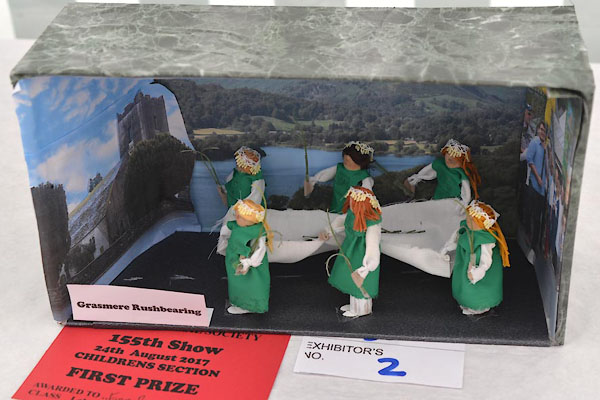 CGK57.jpg |
||||
|
|
||||
 Gentleman's Magazine 1843 |
||||
|
|
||||
| T Machel, at Burton in Kendal, 1692:- |
||||
| :- |
"On St. James's Day they have a rushbearing. The yound maids who perform the solemnity
being entertained with music and such sort of Junkets as the country affords and there
they dance about the Maypole, but none of their mirth is suffered to be enacted in
the church or churchyard." |
|||
| The saint's day is 25 July. |
||||
| Machel, T: 1692: (journal) |
||||
|
|
||||
| James Clarke, 1787:- |
||||
| :- |
"This is an ancient custom, formerly pretty universal here, but now generally disused
... About the latter end of September, a number of young women and girls (generally
the whole of the parish) go together to the tops of the hills to gather rushes; these
they carry to the church, headed by one of the smartest girls in the company. She
who leads the procession is stiled the Queen and carries in her hand a large garland,
and the rest usually have nosegays. The Queen then goes and places her garland upon
the pulpit, where it remains till after the next Sunday; the rest then strew their
rushes upon the bottom of the pews and at the church door they are met by a fiddler
who plays before them to the public house, where the evening is spent in all kinds
of rustic merriment." |
|||
| W Rollinson suggests that the September date is an error. |
||||
| Clarke, James: 1787: Survey of the Lakes of Cumberland, Westmorland and Lancashire:
(London) |
||||
|
|
||||
| A tourist's notebook,Grasmere, 21 July 1827:- |
||||
| :- |
"On entering the church, found the villagers strewing the floor with fresh rushes.
Among the seaons of periodical festivity at this place was the rush-bearing, or the
ceremony of conveying fresh rushes to strew the floor of the parish chuirch. This
method of covering floors was universal in houses, while floors were of earth, but
is now confined to places of worship. The bundles of the girls were adorned with wreaths
of flowers, and the evening concluded with a dance. In Westmoreland the custom has
undergone a change. Billy remembered when the lasses bore the rushes in the evening
procession, and strewed the floors at the same time that they decorated the church
with garlands; now the rushes are laid in the morning by the ringer and clerk, and
no rushes are introduced in the evening procession. I do not like the old customs
to change; for, like mortals, they change before they die altogether. Wordsworth is
the chief supporter of these rustic ceremonies. The procession over, the party adjourned
to the ballroom, a hayloft at my worthy friend Mr. Bell's, where the country lads
and lasses tripped it merrily and heavily. They called the amusement dancing, but
I called it thumping, for he who could make the greatest noise seemed to be esteemed
the best dancer., and on the present occasion I think Mr. Pooley bore away the palm.
Billy Dawson, the fiddler, boasted to me of having been the officiating minstrel at
this ceremony for the last six-and-forty years. He made grievous complaints of the
outlandish tunes which the 'Union Band Chaps' introduce. In the procession of this
evening they annoyed Bill by playing the 'Hunter Chorus is Friskits'. 'Who,' said
Billy, 'can keep time with such a queer thing?' Amongst the gentlemen dancers was
one Dan Burkitt; he introduced himself to me by seizing my coat collar in a mode that
would have given a Burlington Arcade lounger the hysterics, and saying, 'I'm old Dan
Burkitt, of Wytheburn, sixty-six years old - not a better jigger in Westmoreland.'
No, thought I, nor a greater toss-pot. On my relating this to an old man present,
he told me not to judge of Westmoreland manners by Dan's. 'For,' said he, 'you see,
sir, he is a statesman, and has been at Lunnon, and so takes liberties.' In Westmoreland,
farmers residing on their own estates are called 'statesman.' The dance was kept up
till a quarter to twelve, when a livery-servant entered, and delivered the following
verbal message to Billy: 'Master's respects, and will thank you to lend him the fiddle-stick.'
Billy took the hint; the Sabbath morning was at hand, and the pastor of the parish
had adopted this gentle mode of apprizing the assembled revellers that they ought
to cease their revelry. The servant departed with the fiddle-stick, the chandelier
was removed, and when the village clock struck twelve, not an individual was to be
seen out of doors in the village. No disturbance of any kind interrupted the dance.
Dan Burkitt was the only person at all 'how came you so?' and he was non se ipse before
the jollity commenced. He told me he was 'seldom sober,' and I believed what he said.
The rush-bearing is now, I believe, almost entirely confined to Westmoreland." |
|||
| Bogg, Edmund: 1898: Lakeland and Ribblesdale |
||||
|
|
||||
| BPK66.jpg |  |
Market Hall, Ambleside, NY37700446 -- Note the banner about Rushbearing. (photo 2.7.2008) | ||
| CGF46.jpg |  |
St Columba, Warcop, NY74291571 -- Rushbearing favours. (photo 23.6.2017) | ||
| CGF51.jpg |  |
St Columba, Warcop, NY74291571 -- Rushbearing Junior Cup awards. (photo 23.6.2017) | ||
| BJT03.jpg |  |
St Mary, Ambleside, NY37400436 -- The mural of the Ambleside rushbearing, at the west end, was painted by Gordon Ransom, lecturer at the Royal College of Art, evacuated to Ambleside during World War II, 1944. (photo 17.8.2005) | ||
| BSA45.jpg |  |
St Mary, Ambleside, NY37400436 -- Rushbearing mural, detail. (photo 29.1.2010) | ||
| BSA46.jpg |  |
St Mary, Ambleside, NY37400436 -- Rushbearing mural, detail. (photo 29.1.2010) | ||
| BSA47.jpg |  |
St Mary, Ambleside, NY37400436 -- Rushbearing mural, detail. (photo 29.1.2010) | ||
| BST20.jpg |  |
St Theobald, Musgrave, Great Musgrave, NY76761322 -- Rushbearing, 6 July 1886. (photo 11.5.2010) | ||
| BLX53.jpg |  |
St Theobald, Musgrave, Great Musgrave, NY76761322 -- Old print, drawing by R W Billings, engraved by G B Smith. Are the favours on the wall from rush bearing? (photo 21.4.2006) | ||
|
|
||||
| : 1897 (?): Rushbearing, The: Heywood, John (Manchester):: detailed descriptions of
the Grasmere rushbearing Armitt, Mary L: 1912: Church of Grasmere, History: Wilson, Titus (Kendal, Westmorland):: chapter on rushbearing Rawnsley, E F: 1953: The Rushbearing in Grasmere and Ambleside: Wilson, Titus (Kendal, Westmorland):: book, with photographs, poems, and music Rollinson, William: 1974: Life and Tradition in the Lake District: Dent, J M and Co (London) Rowling, Marjorie: 1976: Folklore of the Lake District: Batsford and Co (London) |
||||
|
|
||||
Lakes Guides menu.